المساهمون

يتم التشغيل بواسطة Blogger.
RSS
‏إظهار الرسائل ذات التسميات Science. إظهار كافة الرسائل

Planet has lost half of all marine life since 1970


The oceans, with more than 90% of the habitable space on Earth, still contain most of the life on our planet, but there's a lot less of it than there was just 45 years ago, according to a deeply dispiriting report from the World Wildlife Fund.
The group, which surveyed 10,000 populations of more than 3,000 species, says marine life—including mammals and birds as well as fish—has declined by 49% between 1970 and 2012, the BBC reports.
The WWF says humans have caused the decline in marine species through overfishing, destruction of habitats like seagrass beds and mangrove swamps, and through climate change, which has caused ocean acidification.
Experts warn the latter could cause a "Great Dying" even worse than what has taken place over the last few decades. Some of the steepest declines were among fish caught for food, including tuna and mackerel, which are down almost 75%, the BBC reports.
"In less than a human generation, we can see dramatic losses in ocean wildlife—they have declined by half—and their habitats have been degraded and destroyed," a WWF spokesman tells Discovery.
"Driving all these trends are human actions: from overfishing and resource depletion, to coastal development and pollution, to the greenhouse gas emissions causing ocean acidification and warming." Not as much is known about deep-sea populations, though declining catches suggest they're also dropping fast, the Independent reports.

  • Digg
  • Del.icio.us
  • StumbleUpon
  • Reddit
  • RSS

You can actually hear California's drought


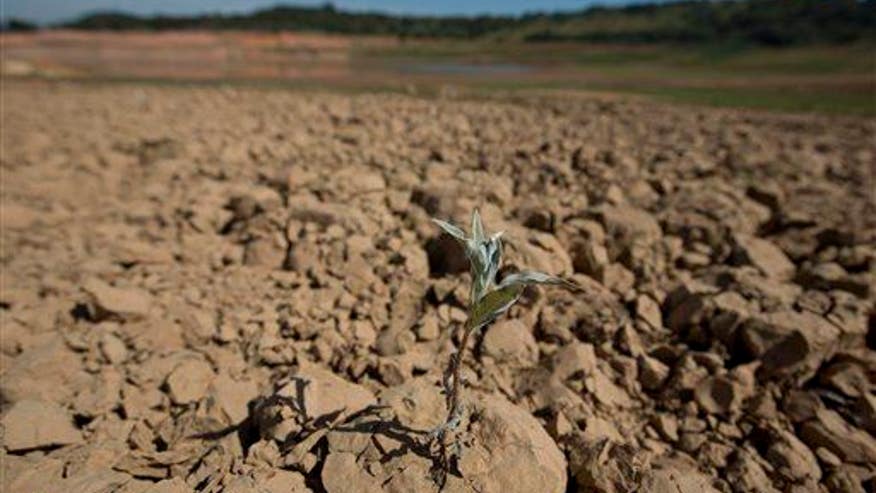
It's easy to look around the West and see startling signs of the region's drought. Trickier, but perhaps just as startling, is to hear signs of that same drought.
Researcher Bernie Krause has made it possible thanks to decades of recordings at California's Sugarloaf Ridge State Park, reports Outside Online. He goes there every spring to the same spot with equipment he's used as a leader in the field of "soundscape ecology," or "ecoacoustics," which the Boston Globe describes as a blend of art and science.
Over the years, a creek that runs through the park has dried up, and the sounds of wildlife—or "biophony"—have dried up along with it. By Krause's measurements, the biophony is down fivefold since 2004.
He is now working with a researcher at the University of Urbino in Italy to translate his recordings into hard data for scientists. “It’s a true narrative, a story telling us that something is desperately wrong,” Krause tells Outside.
Krause himself says he didn't realize the extent of the decline until playing recordings from previous years side by side with more modern ones. At the San Francisco Chronicle, Mark Morford finds Krause's work "chilling," summing up thusly: "What once was a rich, varied symphony of sound has become a far more subdued chamber orchestra, with large spaces of eerie silence where there was once a vast natural racket, signifying everything." The 77-year-old Krause tells the Globe that he's not "terribly optimistic" about change, but “I am hopeful that we’ll begin to hear the message these critters are putting out in time to do something about saving them.” (Scientists now say California's snowpack is at a 500-year low.)

  • Digg
  • Del.icio.us
  • StumbleUpon
  • Reddit
  • RSS

Medieval skeleton discovered in tree suffered violent death, experts say


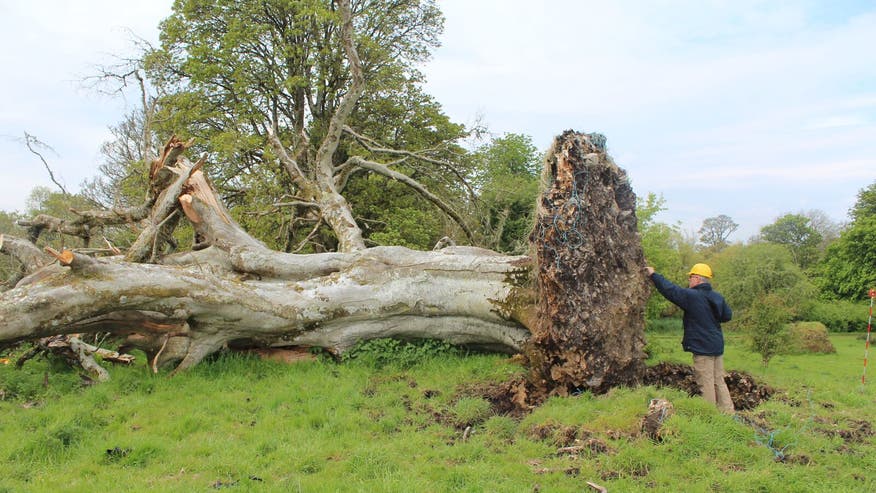
Archaeologists in Ireland have unearthed startling details about the strange medieval skeleton found in the roots of a 215 year-old tree.
The beech tree in Collooney, Sligo, fell during a storm earlier this year, revealing the macabre sight of a skeleton trapped in its roots.  The Irish National Monuments Service brought in experts from Sligo-Leitrim Archaeological Services to excavate and analyze the remains, revealing a grisly tale.
“He had been killed violently,” Marion Dowd, director of Sligo-Leitrim Archaeological Services, told FoxNews.com. “We have stab wounds in the upper chest and they were inflicted by a knife – we also have a stab wound in the left hand, which suggests that he was trying to defend himself.”
The skeleton is of a young man between the ages of 17 and 20. Radiocarbon analysis has dated the remains to between 900 and 1,000 years old.
“We don’t know if he was killed in a battle or if this was a personal dispute,” said Dowd, noting that the body was originally buried in a Christian fashion with its head pointing to the west. “His family or community must have buried him,” she added.
Dowd told FoxNews.com that whoever planted the tree was unaware of the grave. “It’s completely coincidental – the context is unusual,” she said. “There are historical records that say there was a church and graveyard in the area, but there are no remains visible today.”

  • Digg
  • Del.icio.us
  • StumbleUpon
  • Reddit
  • RSS

Seattle dig unearths 10,000-year-old stone tools

An archaeological survey to clear the way for construction near a mall has unearthed thousands of stone tools crafted at least 10,000 years ago.
"We were pretty amazed," archaeologist Robert Kopperl, who led the field investigation, told The Seattle Times. "This is the oldest archaeological site in the Puget Sound lowland with stone tools."
The rare find is shedding light on a time when prehistoric bison and mammoths still roamed what is now western Washington. Only a handful of archaeological sites dating back 10,000 years or more have been discovered in the region.
Chemical analysis of one of the tools revealed traces of the food they were eating, including bison, deer, bear, sheep and salmon. The dig also uncovered a fragment of salmon bone, evidence that the fish made its way up local streams for at least 10,000 years. It also revealed other unusual tools, including the bottoms of two spear points that have concave bases.
The site near Redmond Town Center mall in Redmond, Washington, was initially surveyed in 2009, as the city embarked on a project to restore salmon habitat in Bear Creek, a tributary of the Sammamish River. The creek had been confined to a rock-lined channel decades before.
The Washington State Department of Transportation largely paid for the salmon-restoration project as a way to mitigate some of the environmental impacts of building the new Highway 520 floating bridge over Lake Washington and widening the roadway.
The site appears to have been occupied by small groups of people who were making and repairing stone tools, said Kopperl, of SWCA Environmental Consultants. He and his colleagues published their initial analysis earlier this year in the journal PaleoAmerica.
"This was a very good place to have a camp," Kopperl said. "They could use it as a centralized location to go out and fish and hunt and gather and make stone tools."
Crews initially found unremarkable artifacts. But when they dug deeper, they found a foot-thick layer of peat — remains of a bog at least 10,000 years old. Below the peat, they later discovered a wealth of tools and fragments.
"We knew right away that it was a pretty significant find," Washington State Historic Preservation Officer Allyson Brooks told The Times.
Kopperl said that because of where the artifacts were located below the peat, which had not been disturbed, it's clear they predate the formation of the peat. Radiocarbon analysis conducted on charcoal fragments found with the tools confirmed the age.
"It's hard to find this kind of site west of the Cascades, because it's so heavily vegetated and the Puget Lobe of the big ice sheet really affected the landscape," Kopperl told the newspaper.
A handful of sites have been discovered east of the mountains with tools dating back between 12,000 and 14,000 years.
So it's clear that humans have lived in the area since soon after the glaciers retreated, but a lot of mystery still surrounds the region's earliest occupants and their origins, The Times reported. When Kopperl and his team are done analyzing the artifacts, they will hand them over to the Muckleshoot Tribe for curation. There are no immediate plans to display the artifacts publicly.


  • Digg
  • Del.icio.us
  • StumbleUpon
  • Reddit
  • RSS

Britain Extends Air Strikes On Islamic State


Britain will extend air strikes by RAF Tornados against the Islamic State by an extra year, the UK defence secretary has said.
Michael Fallon has announced that 12 (Bomber) Squadron will continue in service until March 2017.
He said the British jets had helped Iraqi forces on the ground to push militants out of key towns.
"RAF Tornados have carried out hundreds of strikes, helping Iraqi forces push back ISIL from the Kurdish region and out of key towns such as Tikrit and Bayji," he said.
"We want to ensure we maintain this crucial operational tempo and so we will extend the lifetime of Number 12 Squadron for a further year to March 2017.
"This will allow us to sustain our effort, helping the Iraqis lead the fight on the ground."
Speaking during a visit to Baghdad, Mr Fallon said the extension would ensure the RAF retained "the essential precision firepower, intelligence and surveillance" capabilities needed for operations against IS.
The decision was welcomed by the head of the RAF, Air Chief Marshal Sir Andrew Pulford.
"It is clear that the requirement for fast jet precision strike and intelligence gathering shows no sign of diminishing," he said.
The GR4s, operating out of RAF Akrotiri in Cyprus, are equipped with precision-guided Paveway bombs and Brimstone missiles.
They can also be fitted with Raptor reconnaissance pods for carrying out surveillance and intelligence gathering missions.
Together with the RAF's unmanned Reaper drones, also operating in the region, they have flown more than 1,100 combat missions over Iraq.
They have carried out more than 250 air strikes.
During his visit to Baghdad, Mr Fallon held talks with Prime Minister Haider al Abadi and other senior Iraqi government figures.

  • Digg
  • Del.icio.us
  • StumbleUpon
  • Reddit
  • RSS